For years, I have researched and gathered information on the “Polish" branch of our paternal line, anchored by our great-grandfather, Lukas Wisloski. We know he left a port in Galicia in the 1890s, arrived in Philadelphia, and ultimately built a life for our family in the neighborhoods of Roxborough and Manayunk. But in the never-ending quest to understand who we are and where we come from, a recent breakthrough has taken us back an entire generation further—uncovering a vivid, unexpected chapter in our family story.
Through newly discovered and translated documents, we have caught our first real glimpse into the lives of Lukas’s parents, our 2x great-grandparents: Nicolaus Wislocki and Barbara Sztekia.
They lived in Hańczowa, a small village nestled deep within the Carpathian Mountains. While Hańczowa is located in modern-day Poland, during their lifetime it was under the harsh rule of the Austro-Hungarian Empire. The records reveal that Nicolaus—the son of Joannes Wislocki and Anna Dybyk—married Barbara, the daughter of Michael Sztekia and Maria Pirog.
While the documents officially label them as "Ruthenian peasant farmers," the most fascinating piece of this genealogical puzzle is their true cultural identity: our ancestors were Lemko.
The Lemkos are a distinct East Slavic ethnic subgroup. Because of their unique heritage and geographic location, Nicolaus and Barbara walked between two worlds, speaking both Polish and an East Slavic variant of the language. Faith was central to their community; they belonged to the Greek Catholic Church of the Protection of Our Most Holy Lady, a historic wooden sanctuary that remarkably still stands in Hańczowa today.
Life in the Carpathians was a test of sheer survival. Nicolaus and Barbara lived in a traditional chyża—a long log cabin designed to keep both the family and their livestock under a single roof. Space was scarce and the winters were unforgivingly bitter. Nicolaus and Barbara slept in the cabin's only bed, while the older children slept on wooden benches lined against the perimeter of the room. To keep from freezing, the youngest children slept huddled together on the floor directly in front of the clay stove.
By the 1890s, extreme and systemic poverty gripped Hańczowa, triggering a historic mass migration to the United States. Driven by the hope of a better future, great-grandfather Lukas and his brothers joined this wave, leaving their mountain village behind for the shores of America.
While I look forward to sharing more details about Lukas and his youngest daughter, Julia, at a later date, today we honor Nicolaus and Barbara. Their resilience in the face of poverty and brutal winters paved the very path that brings us here.
As a post note; Lukas’s wife (great grandmother) Eva Dolhanczyk’s family lived in Biala Woda which is two hours west of Hanczowa in the same mountainous area and of Lemko/Ruthenian Heritage. 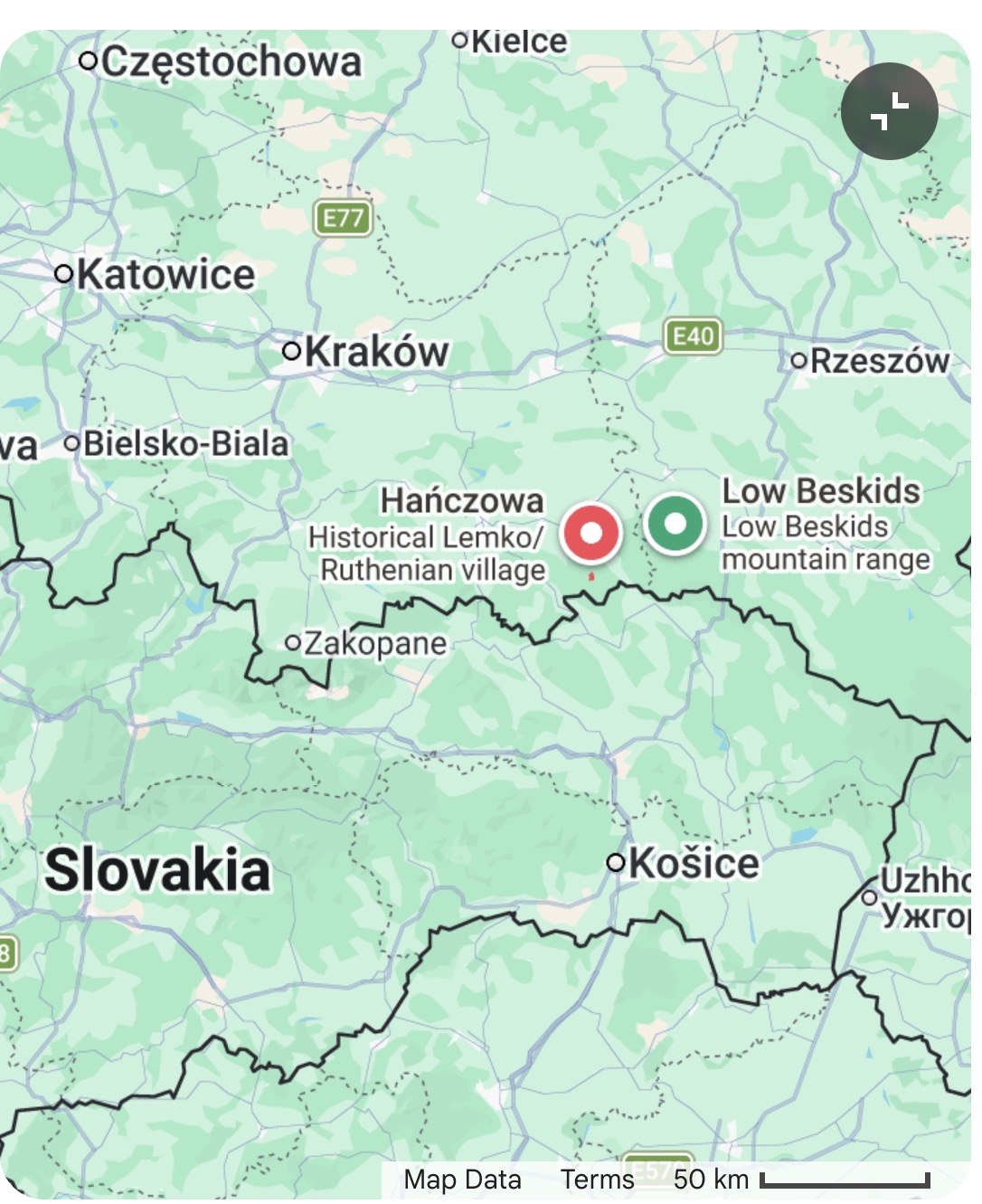

No comments:
Post a Comment